

Slot Machine Denominations Explained
Learn how slot machine denominations work and how they affect your bet size, credits, paylines, payouts, RTP, volatility, and jackpot potential. Find out the differences between penny, cent, and dollar denominations, and find out how to choose the right denomination for your bankroll and playing style.
In this guide you will find:
- What Does the Denomination Mean on Slot Machines?
- How Does the Denomination Work on Slot Machines?
- How Denomination, Credits, and Paylines Work Together
- How Denomination Impacts Your Bet Level
- What Does Changing the Denomination on a Slot Machine Do?
- What Is the Difference Between Denomination and Bet Size?
- Best Denomination to Play Slot Machines
- How Do Denominations Affect Progressive Jackpots?
- Slot Denomination Strategies
- Common Slot Denomination Mistakes
- Slot Denominations FAQ
What Does the Denomination Mean on Slot Machines?
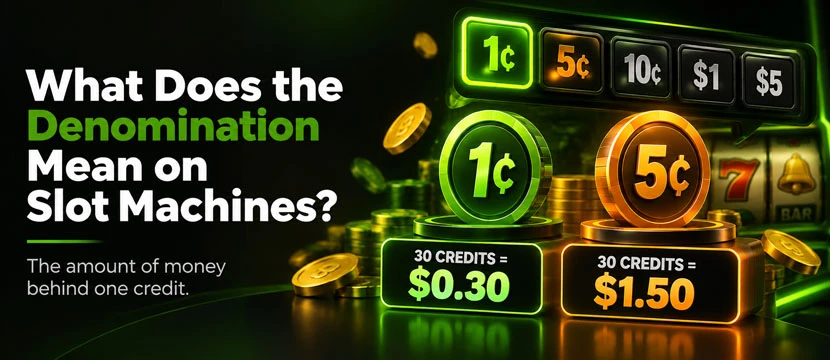
The denomination on a slot machine is the amount of money behind one credit. A penny, a nickel, a quarter, whatever the machine offers. It's not the price of a spin, though. That's something I think the name "penny slot" makes unnecessarily confusing.
You might sit down at a 1-cent machine and find that the smallest bet is 30 credits. Thirty credits on a penny slot? That's $0.30 a spin. But if you change to 5-cent credits and leave the bet where it is, you're looking at $1.50 instead.
And that's really what I'd look at first. Not the little denomination label somewhere on the screen, but the total bet. It's possible to spend more on a penny slot than on a machine using dollar credits. Depends how many the game wants you to play.
How Does the Denomination Work on Slot Machines?
You've got $20 in the machine. At 5 cents, that's 400 credits to play with. At 10 cents? Only 200. Still the same $20, of course. Switch to 10 cents and you'll only see 200. You haven't lost half your money. Each credit is simply worth twice as much now. Shift that over to a 10-cent denomination, and that exact same $20 bill drops down to 200 credits.
Your underlying cash remains identical, of course. It’s purely a matter of how the machine translates your dollars into playable units. What I'd check before spinning is how many credits the machine is taking for each bet.
Why Do Slot Machines Have Different Denominations?
Not everyone wants to spend the same amount on a spin. That's one reason you'll find machines with penny credits and others where a single credit costs $5. Someone playing with a tighter $50 budget is naturally going to stick to low-tier penny options, while a high roller might head straight for the $1 or $5 credit lines.
Casinos also implement multiple denominations to make their games more versatile. You’ll find some slots fixed at one specific credit rate, but plenty of games let you change settings whenever you want. Just be careful when moving to a higher denomination. If you leave the credit bet unchanged, you'll end up paying more for every spin.
How Denomination, Credits, and Paylines Work Together
Denomination, credits, and paylines all play a part in how much you pay for a spin. We've already covered denomination, but there's more to your bet than the value of a single credit.
Paylines are the lines across the reels where symbols can form winning combinations. On older slots, you may be able to pick how many of these lines you want to play, along with the number of coins you put on each one.
Say you've got 20 paylines switched on, with 2 coins on each line. At 5 cents per credit, the calculation looks like this:
- 20 paylines × 2 coins = 40 credits
- 40 credits × $0.05 = $2 per spin
Now, drop the bet to 1 coin per line and you're down to $1 per spin. The denomination hasn't changed at all. One thing to watch is that not every slot lets you adjust the paylines. Many newer games have fixed lines or use ways to win instead. In those cases, it's better to check the total bet shown in the game rather than trying to work it out from the number of paylines.
How Denomination Impacts Your Bet Level
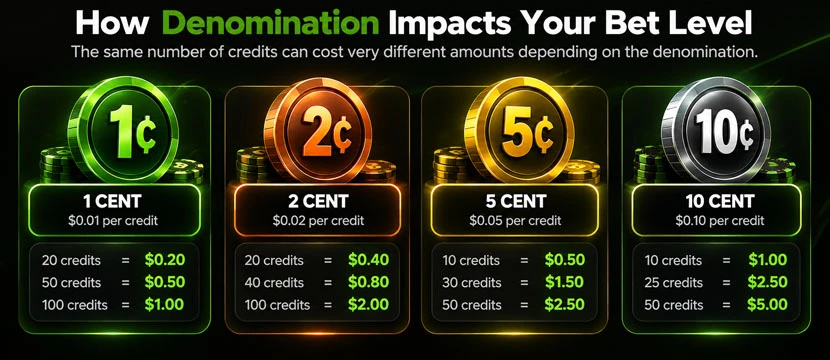
The difference between a penny slot and a 10-cent slot becomes pretty obvious once you look at the bets. Put 20 credits on a spin, and you're paying $0.20 on the penny machine. At 10 cents per credit, that same spin will set you back $2. Let's go through the common denominations, from penny slots to the more expensive dollar machines.
1 Cent Denomination Slot Machine
Penny slots use credits worth $0.01 each. They're popular with players looking for smaller bets, but the name can be misleading. You won't necessarily find a one-cent spin. Take a game with 50 paylines that requires one credit on each line. That's 50 cents every time you spin. And some penny slots have minimum bets well above that.
2 Cent Denomination Slot Machine
A 2 cent denomination slot machine uses $0.02 credits. Not much of a jump from penny slots, right? Well, it depends on how many credits you're playing. Here's what different credit bets cost:
- 20 credits = $0.40
- 40 credits = $0.80
- 100 credits = $2
At the 1-cent denomination, those same bets would cost half as much.
5 Cent Denomination Slot Machine
Nickel slots, as they're usually called, have credits worth $0.05. Put 30 credits on a spin and you've got a $1.50 bet. Coming from penny slots? Watch out for the difference. At a nickel a credit, that same 30-credit bet jumps to $1.50. Quite a leap from the 30 cents you were paying on the penny setting.
10 Cent Denomination Slot Machine
On a 10 cent denomination slot machine, every credit is worth $0.10. You don't need a particularly large credit bet to reach a few dollars per spin. For example:
- 10 credits = $1
- 25 credits = $2.50
- 50 credits = $5
At 25 credits per spin, playing 60 rounds would mean $150 in total wagers. That's the amount bet across those spins, not necessarily what you'll lose.
$1 Denomination Slot Machine
Dollar slots work a little differently from the penny machines with dozens of credits per spin. On a traditional $1 slot, you might be able to choose between one, two or three credits. That would give you bets of $1, $2 or $3. Of course, newer machines can have other betting requirements, so don't assume every dollar slot starts at $1.
$5 Denomination Slot Machine
With a $5 denomination slot machine, even one credit is a fairly big bet. Three credits? That's $15 for a single spin. These machines are generally found in higher-stakes areas of land-based casinos. A $100 bankroll would cover just 20 spins at $5 each if you didn't win anything along the way. At $15 per spin, you'd only have enough for six full spins.
$10 Denomination Slot Machine
A $10 denomination slot machine isn't something you'd normally pick for casual, low-budget play. One credit already costs $10, and three credits bring the bet to $30. Here's how quickly the total wagers add up at $30 per spin:
- 5 spins: $150
- 10 spins: $300
- 25 spins: $750
Those figures don't account for winnings, of course. They simply show how much money passes through the game at that bet level.
What Does Changing the Denomination on a Slot Machine Do?
Changing the denomination on a slot machine means putting a different dollar value on each credit. Say you've been playing at 2 cents and decide to try 10 cents instead. Your 40-credit bet has just gone from $0.80 to $4. Quite a difference, especially if you didn't notice the total bet changing. On some machines, that's all there is to it. On others, you may find that the prizes or even the game settings are a little different.
How Do Slot Machine Denom Affect Payouts?
Let's say the paytable gives you 200 credits for a particular combination. On a penny slot, that's $2 in your balance. Make those credits worth a dollar each and the prize becomes $200. Well, at 1 cent it's just $2. At 5 cents you're looking at $10, and on a dollar machine those 200 credits would be worth $200.
Of course, that only works if the credit prizes stay the same. Some machines change the paytable when you move between denominations, so the maths won't always be quite so neat. You might find different credit prizes at different settings, which makes a straight comparison a bit harder.
And personally, I'd pay more attention to the total bet than the size of the prize. I'd be more interested in what I spent getting that $200 win.
How Slot Denomination Affects RTP and Volatility?
Slot denomination can affect RTP and volatility on certain machines. On plenty of others, it makes no difference at all.
Take RTP first. Take a game with 96% RTP. That 96% comes from its theoretical performance over an enormous number of spins. It doesn't mean you'll get $96 back after betting $100, and it certainly doesn't tell you what will happen in one session.
Volatility is a separate thing. Ever played a slot that keeps giving you little wins, then another where you can go ages without much happening? That's roughly the difference between lower and higher volatility. The second type may have bigger prizes, but you could be waiting a while for one.
Now, changing from 5-cent credits to 25-cent credits won't necessarily alter either of those things. It depends on whether the machine uses the same game settings at both denominations.
Do Higher Denomination Slot Machines Have Higher RTP?
Higher denomination slot machines sometimes offer a higher RTP. This is particularly relevant to traditional casino floors, where penny machines and dollar machines don't always have the same average returns.
Nevada's gaming statistics are often brought up here. They've shown better average returns for some higher-denomination categories. But there's a big difference between comparing hundreds of machines and changing the denomination on the one you're sitting in front of.
With online slots, I'd be even more careful about making that assumption. A game can have the same RTP at every bet level. Some providers also release several RTP versions of a title, but betting $10 instead of $1 doesn't automatically move you to the better version.
Can Changing Denom Affect Your Odds?
Changing denom can affect your odds if the slot has different rules or maths at different credit values. Otherwise, why would the symbols suddenly become more likely to land just because you've raised the denomination?
Imagine a game where three matching symbols pay 80 credits. At 5 cents, that's $4. Switch to 25 cents and the same combination is worth $20. You're spending five times as much per credit, though, and the chance of hitting those symbols could be unchanged.
One thing I would check separately is the jackpot. Some machines have prizes that only become available at certain denominations or minimum bets. We'll look at those in more detail later.
What Is the Difference Between Denomination and Bet Size?
A slot's denomination tells you what one credit costs. Your bet size? That's how much you're actually putting into a spin. And the two numbers can be quite different. Say you want to play for $2 a spin. Depending on the denomination, you could be betting:
- 200 credits on a 1-cent machine
- 40 credits at 5 cents
- 20 credits at 10 cents
- Just 2 credits on a dollar slot
You're spending $2 either way. It's the credit count that's changing, not the money coming out of your balance.
There's one problem with this example, though. You can't always choose exactly how many credits to bet. Some slots have fixed paylines, others give you a handful of preset bet levels. So that $2 option might not even be available at every denomination.
I'd look at the Total Bet display before anything else. A penny slot can easily cost more per spin than a dollar slot if you're playing enough credits.
Best Denomination to Play Slot Machines
The best denomination to play on a slot machine depends quite a bit on the actual bet. I've seen penny slots where a spin costs more than on a machine with 5-cent credits. Sounds strange, but it's simply because the penny game asks you to play more credits.
So I wouldn't pick a machine based on the denomination alone. First, I'd see how much a spin costs and whether that amount works with the money I've set aside.
Based on Your Bankroll
Your bankroll is probably the easiest place to start. Got $50 to spend? A machine charging $0.50 per spin gives you 100 bets to work with, assuming you don't win anything back. At $2.50, that drops to just 20.
And 20 spins can go by pretty quickly.
There's no particular denomination you have to choose for a $50 budget. You might find a penny game with a reasonable minimum bet, or a nickel slot that works out cheaper. I'd compare a few rather than going straight for the lowest denomination.
More Spins, Lower Bet
Lower bets generally give you more spins for the same amount of money. The denomination can help you get there, although sometimes the numbers are a bit misleading. Here's an example. You've found two machines:
- One uses 1-cent credits, with a minimum bet of 80 credits. That's $0.80 a spin.
- The other uses 5-cent credits, but only asks for 10. You're paying $0.50.
I'd take the second one if my aim was to keep the cost down. The penny label doesn't really mean much once you've worked out the total bet.
With $40, you could afford 50 spins on the penny machine or 80 on the nickel slot, assuming you didn't win anything back. Quite a difference for two machines that seem to be priced the other way around.
Balance RTP and Bankroll
You need to check RTP when you're choosing a slot denomination, but I wouldn't get too caught up in a difference of one percentage point. Imagine finding a game with 97% RTP, except its minimum bet is $5. Next to it, there's one with 96% RTP where you can play for $0.50. That 97% RTP is tempting, I get it. But with $40 in your pocket and $5 going on every spin, you haven't got much room for a bad run. I'd stick with the cheaper machine in this case. One extra percentage point isn't enough to make me spend ten times as much on a spin.
Why Use a Slot Denomination Calculator?
A slot denomination calculator is useful when the machine shows everything in credits and you just want to know how much you're spending. Say you've got 75 credits at 5 cents each. That's $3.75 a spin. Easy enough to calculate, but when you're comparing several denominations and bet levels, it's nice to have the numbers worked out for you.
When to Move Up or Down in Denom?
Moving up in denomination is really a question of whether you want to spend more per spin. Say you've been playing at 2 cents and you're curious about the 5-cent setting. Have a look at the total bet. If it's still within your budget, fine. If it's suddenly costing several dollars, maybe not.
Going the other way is sometimes the better call. Perhaps you've picked a machine, played a few rounds and realised the bet is eating through your balance faster than expected. Dropping to a cheaper setting, if the game allows it, means putting less money on each spin.
I wouldn't move up just because I've lost a few times, though. It's tempting to think a bigger bet might help recover the money, but the next spin doesn't know what happened on the previous ones.
How Do Denominations Affect Progressive Jackpots?
Progressive jackpots can work differently depending on the slot denomination. You might see a prize worth thousands of dollars on a penny machine, then find a completely different jackpot when you switch to quarters.
You can't really tell just by looking at the jackpot amount. Two denominations might feed into the same prize, or each could have its own jackpot. Sometimes there's also a minimum bet to worry about.
Can a Higher Denomination Give You a Bigger Jackpot?
With some progressive slots, moving up in denomination also means playing for a larger jackpot. Take a prize displayed as 10,000 credits. If each credit is worth a penny, that's $100. At 25 cents, those credits would be worth $2,500.
That's assuming the machine actually uses the same credit-based prize at both settings. It might not. I've also come across games where the jackpot is displayed in dollars rather than credits. In that case, switching denominations doesn't necessarily change the amount on the screen.
I've also seen machines with separate jackpots for each denomination, so the amount on offer isn't even the same when you switch.
Do You Have to Bet Max Credits for a Progressive Jackpot?
Progressive jackpot rules aren't always as straightforward as the big prize displayed above the reels. On some older slots, you need to bet the maximum number of coins to qualify for the top jackpot.
Other machines don't ask for a max bet at all. They might have a minimum stake, a particular denomination you need to select, or a jackpot that's available across several bet levels.
I'd check the paytable before putting any money into a machine. Imagine playing for half an hour, hoping to hit the top prize, only to realise your bet doesn't qualify. Not a great discovery.
Does a Bigger Bet Improve Your Jackpot Odds?
Bigger bets don't always mean better jackpot odds. On one machine, raising the denomination might simply make every spin more expensive. Your chance of triggering the progressive stays the same. On another, the jackpot rules could give different bet levels different chances. There are also games where certain prizes aren't available until you meet a minimum bet.
So I wouldn't raise the denomination just because the jackpot looks tempting. First I'd want to know whether the higher bet actually changes my chances, or whether I'm paying extra for exactly the same shot at the prize.
Slot Denomination Strategies
I've never been convinced by slot denomination strategies that tell you to switch from pennies to nickels after a certain number of spins. Why would that make any difference? If the game uses the same maths, you're just paying more for each credit.
There are a few things worth trying, though. Say you're looking at a machine with three denominations: 1 cent, 5 cents and 10 cents. Before playing, I'd flick between them and see what happens to the total bet. Sometimes the difference is bigger than you'd expect. And occasionally, the lowest denomination isn't even the cheapest way to play.
Then there's the paytable. I know, most people probably don't spend much time looking at it. But I'd be curious whether a win pays the same number of credits at each denomination. Or whether the jackpot changes. You might find that the only real difference is the amount of money you're putting on each spin.
One thing I wouldn't bother with is changing denominations every time the game goes quiet. Ten losing spins at 1 cent don't make a win more likely at 5 cents. Same goes for moving up after a big payout. There's no reason to think the next few spins will be just as good.
And watch those credit bets. It's easy to leave the counter at 60 credits, switch to a 10-cent denomination and suddenly find yourself spending $6 a spin. That's quite a jump if you were playing for 60 cents a minute ago.
Sometimes I'd simply walk away from that machine and find another one with smaller bets. Not much of a strategy, perhaps. But better than trying to make an expensive slot fit a budget it was never going to suit.
Common Slot Denomination Mistakes
Most slot denomination mistakes happen when you're looking at the credits and forget to check what they're actually worth. I've caught myself doing the maths twice on machines with several bet settings. It's surprisingly easy to miss a dollar amount when everything is displayed in credits. A few things to watch for:
- Thinking penny slots are always cheap. A penny is just the value of one credit. If the machine wants 100 credits per spin, that's $1 gone every time you press the button.
- Switching denominations and leaving the credit bet untouched. Say you're playing 30 credits at 2 cents. That's $0.60. Move to 10 cents and you're now spending $3 a spin. Same 30 credits, much bigger bet.
- Picking a dollar slot because you've heard it has better RTP. Maybe it does, maybe it doesn't. I'd want to see the actual RTP before spending more on every spin.
- Forgetting about jackpot requirements. You could be looking at a huge progressive prize while playing at a bet level that doesn't even qualify for it. Check before you get too interested in that number.
- Getting carried away with the credit balance. Seeing 800 credits on the screen feels like quite a lot. But at 1 cent, you've only got $8. At 5 cents, it's $40.
- Raising the denomination to recover a loss. This one can get expensive quickly. A few bad spins at 5 cents don't mean switching to quarters will somehow turn things around.
And don't assume the paytable stays identical when you change denominations. Some machines have different prize values or jackpot rules. I'd have another look before playing at the new setting.
Slot Denominations FAQ
What Does Denom Mean in a Slot Machine?
Denom? That's just the credit value. If it says 25¢, each credit is worth a quarter. You still need to check how many credits you're betting.
What Is the Best Denomination for Slot Machines?
I'd pick based on the bet, really. Give me a nickel slot with a 50-cent spin over a penny machine charging $1.20. Why spend more for the sake of playing pennies?
What Is the Highest Denomination Slot Machine?
$100 a credit is possible, sometimes more. Those machines belong in high-limit rooms, though. Not the sort of thing you'll normally find beside the penny slots.
What Denomination Slot Machine Has the Best Odds?
You can't judge that from the denomination. Two machines might have different RTP figures, while two settings on the same machine could have identical odds. I'd look at the actual game.
Are Penny Slots Really Cheap to Play?
Only if the total bet is cheap. I've seen 1-cent games asking for over a dollar per spin. The penny label doesn't help much then.
Do Higher Denomination Slots Pay More?
They can pay a lot more in cash. A 20-credit prize at $5 a credit is $100. On a penny machine? Twenty cents. But those bigger credits aren't free, and the paytable might differ too.