

Casino Loyalty Programs in Mexico and Argentina: Key Mechanics and Retention Strategies
We analyzed the loyalty programs of 15 operators in Mexico and Argentina – from traditional casinos such as Codere and Betcris to crypto platforms Gamdom and Shuffle – and looked at how their levels, coins, quests, cashback and VIP mechanics are structured.
A joint editorial by ggrboost & SlotCatalog
We analyzed the loyalty programs of 15 operators in Mexico and Argentina – from traditional casinos such as Codere and Betcris to crypto platforms Gamdom and Shuffle – and looked at how their levels, coins, quests, cashback and VIP mechanics are structured.
The result is a market map that operators can rely on when launching or refining a loyalty program of their own. The research was conducted by the ggrboost.io x SlotСatalog team.
The market at a glance
In most cases, operators’ loyalty programs combine several interlinked mechanics. Players earn points for activity, move up a level and unlock new rewards. This approach is used by Winpot, Fortunazoar, Maggico and Betbox, among others.
That said, each market has its own focus.
In Mexico, classic VIP systems with a clear level structure, cashback and cash rewards are more common. Winpot and AFun use this format.
In Argentina, the emphasis is on gamification, including missions, temporary multipliers, customizable rewards and regular bonuses — from instant to monthly (Fortunazoar, Maggico).
The same split shows up in what players see first. In Mexico, the top of the casino lobby is close to a single-provider shelf: according to SlotCatalog's lobby rankings, eight of the twelve most visible games are Pragmatic Play slots. In Argentina, the mix is wider, and live game shows such as Crazy Time and Ice Fishing sit next to slots in the top twelve. A program there has to reward play across several formats from the very first level.
Platform requirements
Most operators in the sample run in-house solutions (AFun, Gamdom); third-party platforms are less common (Playtech at Codere, Wiztech Group at Winpot). If you are choosing or upgrading the technical foundation for your program, the minimum set of requirements is as follows:
- points accrual and level progress calculation;
- automatic cashback payouts;
- configurable rewards for player actions;
- creation of tasks and tournaments;
- user segmentation;
- dedicated VIP logic for the most valuable players.
Entry threshold
Entry thresholds across the sample are fairly low: 50–200 MXN in Mexico and 2,000–5,000 ARS in Argentina, depending on the operator and payment method. This is a deliberate choice: a low threshold brings almost any depositing player into the loyalty program, not just high rollers. At the same time, many operators effectively have no separate entry threshold for VIP. Players join the loyalty program from their very first bets and are automatically placed on the starting level.
How the level system works
Levels are the backbone of most loyalty programs in the study. Player activity is converted into points, after which the user receives a new status and access to additional benefits.
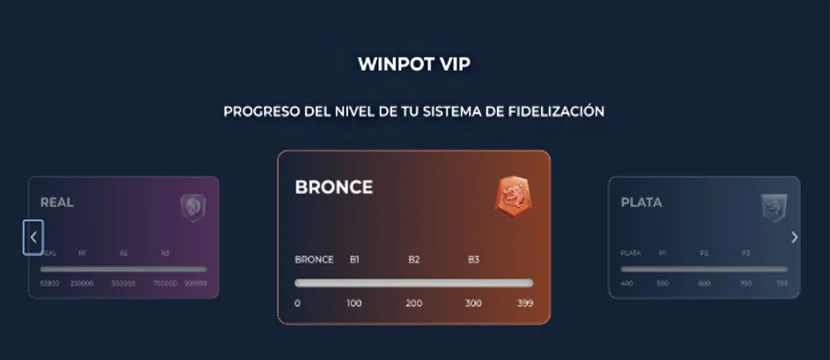
Most often, operators use between four and eight levels. Codere has built a four-level system. Winpot has six, Maggico seven and Gamdom eight.
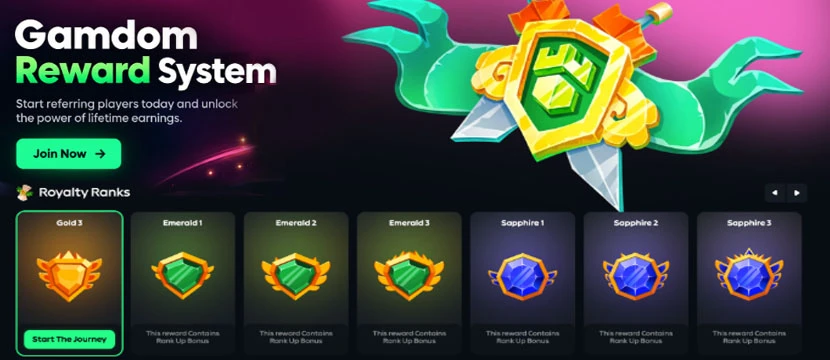
Some operators, however, opt for a longer structure. AFun and MexBoss each have 15 levels, while Fortunazoar has 36.
A large number of levels makes it possible to show players their next goal more often. Users can see how far they are from the next status, which gives them extra motivation to stay active.
The value of the available benefits grows as players progress. Depending on the operator, they may receive more free spins, higher cashback, cash bonuses or additional perks within the VIP program.
Coins and progress
In-house currency remains one of the core elements of loyalty programs. It is used to calculate progress and can sometimes be exchanged for rewards.
There is no single market approach to awarding points. Each operator sets its own rules and the value of activity.
At Winpot, for example, 50 MXN wagered in Casino and Sports earns 1 point, while in Live Casino it takes 500 MXN in wagers to earn a point.
At Fortunazoar, the system depends on the product vertical. For every 100 ARS, a player earns 1 point in Live Casino, 2 points in slots and 3 points in the sportsbook.
Lower rates for live games follow the margin: live tables return more to the player, so each peso wagered there is worth less to the operator. The catch is that the lobby may be pushing exactly those games. If game shows hold the top lobby positions but earn half the points of slots, the most promoted content becomes the slowest way to level up. "Product weights are usually set against the P&L, but they are worth checking against the lobby as well," says Mykhailo Kachanov, CBO at SlotCatalog. "Players feel the gap between what the casino shows them and what actually moves their progress."
Some operators vary the value of points according to the user’s level.
At Betcris, 1,000 BetPoints are worth a different amount depending on the player’s status: 60 MXN at Bronze and 140 MXN at Diamond.
Maggico’s mechanic deserves a separate mention. At different levels, players temporarily earn points at a boosted rate. A multiplier can, for example, speed up accumulation several times over for a limited period.
This gives players an extra reason to come back and play while the boost is active.
Rewards
At most operators, rewards grow in size with the level — and the range of rewards available changes too.
At the start, these are typically free spins, bonus money, cashback, points and level-up bonuses. Higher levels add increased cashback, regular (weekly and monthly) rewards, reload bonuses and personalized VIP offers.
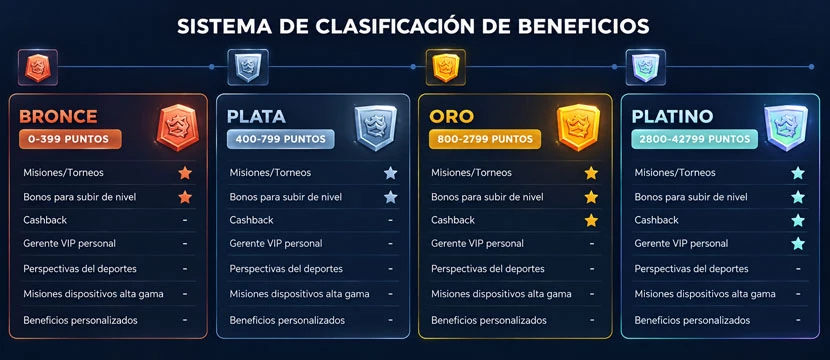
Level-up rewards stand out in particular. At Winpot, they go as high as 10,000 MXN and 100 free spins, while Fortunazoar awards 8,000 ARS on entry to VIP and offers a choice between 100 free spins and a 15,000 ARS free bet.
The game behind the free spins matters as much as their number. A hundred spins feel more valuable in a title the player already knows from the lobby: Gates of Olympus 1000 or Big Bass Bonanza in Mexico, Joker's Jewels in Argentina, all near the top of local SlotCatalog rankings. Volatility is the second lever. At early levels, a lower-volatility game makes a visible win more likely, and that is exactly what a level-up moment needs.
Cashback also rises with status: up to 20% at Betbox, up to 20% at AFun and up to 25% at Gamdom. At some operators, the value of the reward itself changes too. At Betcris, for instance, points become worth more as the player’s status rises.
Progression is therefore built not only on the principle of “the higher the level, the bigger the bonus”, but also on gradually unlocking new types of rewards.
Quests and missions
Tasks are an additional way to keep players active between level-ups.
The programs in the study feature various types of tasks. Operators offer gameplay activities, deposit tasks, seasonal events and other goals tied to user behavior.
The format depends on the business objective. Some tasks help increase visit frequency, while others encourage the use of specific products or gather additional information about the player.
At Fortunazoar, tasks sit in a dedicated section within the loyalty program. Completing them earns the same points used for level progression. This makes it possible to combine several mechanics within one system without creating a separate currency for each activity.
The frequency of tasks also varies. They may refresh daily, weekly or monthly, or appear as part of specific events. For event-based tasks, the local calendar beats the global one. SlotCatalog's analysis of Google Trends data for Argentina shows interest in Halloween-themed slots peaking every October and growing year on year. Christmas titles get no December lift at all, since December is summer there. Football is the strongest wild card: search interest in Penalty Shoot Out rose sharply in early 2026, months before the World Cup.
VIP
In most of the projects reviewed, VIP levels are built into the overall progression system.
As their status rises, players receive more valuable benefits. These may include higher cashback, additional bonuses, a personal manager, priority support, faster withdrawals or invitations to exclusive events.
This structure helps segment players by value and offer different terms to users with different levels of activity.
VIP should not, however, exist separately from the main loyalty program. When players understand how their current actions affect their progress, the system becomes more transparent and predictable.
Top five mechanics worth adopting
From the full review, we singled out five mechanics with the greatest potential for implementation.
1. Different activity weighting across products
At Fortunazoar, points are awarded differently depending on the product. Live Casino, slots and sports carry different rates, so player activity can be steered toward the desired sections.
2. Regular and event-based tasks
Winpot offers gameplay, deposit and calendar tasks. They provide an extra goal between level-ups and a reason to return regularly.
3. Cashback that grows with the level
At AFun, cashback increases as status rises. Players immediately see the concrete benefit of moving up to the next level.
4. Temporary ×2/×3 point multipliers
Maggico uses temporary multipliers that let players accumulate points faster for a limited period. It is a good mechanic for a short-term boost in activity.
5. Level-up rewards
Winpot and Fortunazoar show how a tangible reward amplifies the level-up moment itself. At Winpot’s upper levels, that means up to 10,000 MXN and 100 free spins; at Fortunazoar, entry to VIP brings 8,000 ARS plus a choice between 100 free spins and a 15,000 ARS free bet. Players immediately receive cash, free spins or the option to choose a bonus, which effectively highlights the move to a new level.
How to build a loyalty program into retention communications
A loyalty program does not have to become a standalone, permanent theme of retention communications. Once players are familiar with the mechanics, information about status, points and progress is more often woven into the operator’s other activities — game and provider promotions, tournaments, missions, bonus campaigns and personalized offers.
Dedicated communication about the program itself is needed at specific points: at launch, on a level-up, when a reward is received, when the next status is within reach, when points are about to expire or when progress is temporarily boosted.
Email suits communications where the player needs more context.
After registration or the first deposit, the operator can explain how the program works, what levels exist and which benefits are available from the start.
A separate scenario is level-up notifications. These messages should show the specific change — for example, the new cashback rate or the reward now available.
Emails with progress updates are also effective. If a player is just a few points short of the next level, a reminder of the goal can further stimulate activity.
Another use case is a roundup of current tasks. If the operator has a dedicated missions section, email helps remind players of the available activities and their deadlines.
A further scenario is communications that speed up a player’s progress. Some operators in Latin America, such as MyStake, offer a selection of slots with double loyalty points. This mechanic is particularly useful for players at the early levels who have not yet moved into the VIP segment, and it provides a regular reason for an email campaign. Emails can feature selections of games with ×2 progress, temporary multipliers or individual slots that accelerate the move to the next level. The choice of games is a lever in its own right. Familiar lobby favorites make the offer easy to accept. New releases gain the most: a game far from the lobby's first screen gets little attention, and a points boost is one of the few tools that can change that. This makes ×2 selections a natural format for campaigns co-funded with game providers.
Communications relating to points expiry or a change in status deserve particular attention. In these cases, an email makes it possible to explain the terms in advance and avoid a situation where a user loses accumulated progress without warning.
For players who have reached a high status, dedicated VIP program invitation scenarios can be used. These messages usually focus on the new opportunities that open up after the level-up.
On-site pop-ups
Pop-ups work best when an immediate response is needed while the player is active.
For example, if an operator launches a temporary points boost, a pop-up can announce it while the user is in the game.
The format also works for reminders about unfinished tasks. The player can go straight to the relevant section and complete the goal.
Another scenario is a level-up notification. The message appears as soon as the required threshold is reached and helps reinforce the value of the new status.
Pop-ups can also be used ahead of reaching a VIP level. If a player is close to the next status, displaying their progress shows how far they are from the new goal.
How the channels work together
The loyalty program is rarely the main hook of an email or pop-up. The communication usually centers on a specific activity — a slot or provider promotion, a tournament, a promo, social media or another offer. Loyalty information tends to be added on top: status, progress or the chance to speed it up is placed in the header, footer or a separate block of the email.
Provider campaigns are also the easiest base for missions. Pragmatic Play games run at almost every casino SlotCatalog tracks in Mexico and Argentina, so network promotions such as Drops & Wins are already live in most lobbies. A task like "play three Drops & Wins games this week" turns them into loyalty progress without a separate prize budget.
The key is not to repeat identical messages across every channel. Email is better for explaining mechanics, for reminders and for communications that do not require an immediate response. Pop-ups suit in-session situations, when the player is already in the product and can take the desired action straight away.
For example, an email can give advance warning that points are about to expire, while an in-game pop-up can show an active points multiplier or remind the player of an unfinished task.
Dividing the roles this way makes communication more useful and avoids overloading the player with identical messages.
Conclusion
The analysis of loyalty programs at operators in Mexico and Argentina shows that an effective system is usually built from several interlinked elements.
Levels help set a long-term goal and show players the direction of travel. Tasks and time-limited activities sustain regular engagement with the product. Cashback and VIP benefits reinforce the value of a high status.
The mechanics only work, however, when players understand the rules, can see their progress and can link their current activity to a concrete benefit within the program.
One more element sits outside the program itself: the lobby. The program defines the reward, but the lobby decides which games players open to earn it. Product weights, free-spin rewards and seasonal missions work best when they are checked against what players actually see first.
A loyalty program should therefore be treated not as a separate communication stream but as a layer of the overall retention mechanics. Level, points, rewards and progress can strengthen game promotions, tournaments, missions and personalized offers, becoming a talking point in their own right at moments when the player’s status or available benefits genuinely change.