

Slot Machine Paylines: A Comprehensive 2026 Guide
Slot machine paylines are the exact directional patterns on a slot game's reels where matching symbols must land to trigger a payout, serving as the foundational mechanic of many modern and classic titles. Whether you are navigating traditional three-reel games with a single horizontal line or engaging with advanced video slots featuring thousands of interconnected ways to win, paylines dictate precisely how every spin is mathematically evaluated and rewarded.
- Filter
SlotRank


 1
1 










Items: 54441 / Displaying 1 - 12
In this guide you will find:
Slot machine paylines are the exact directional patterns on a slot game's reels where matching symbols must land to trigger a payout, serving as the foundational mechanic of many modern and classic titles.
Whether you are navigating traditional three-reel games with a single horizontal line or engaging with advanced video slots featuring thousands of interconnected ways to win, paylines dictate precisely how every spin is mathematically evaluated and rewarded. Explore data-driven insights provided by SlotCatalog and understand the complex relationship between active payline structures, baseline betting amounts, and overarching game volatility to make highly informed, responsible gaming decisions.
What Are Slot Machine Paylines?
Slot machine paylines, frequently referred to as betting lines or winning lines, represent the predetermined paths across the reels that dictate whether a spin results in a payout. In traditional, vintage slot machines, a payline was typically a single, straight horizontal line running directly across the center of three mechanical reels. If three matching symbols landed exactly on that central line, the player received a reward based on the game's paytable.
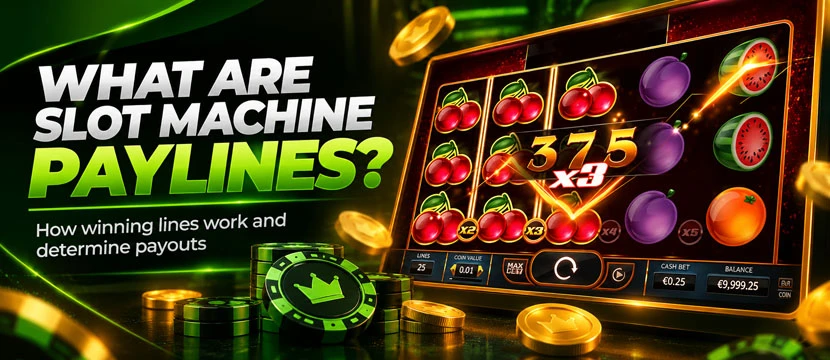
As iGaming technology evolved and games transitioned from physical mechanical reels to digital screens, developers gained the mathematical flexibility to introduce complex payline mechanics. Today, a payline does not have to be a straight horizontal line. It can zigzag across the screen, form a V-shape, run diagonally, or follow asymmetrical patterns across five or more reels. Modern online titles can feature anywhere from five to over a hundred specific, mapped paylines.
When a player initiates a spin, the game's internal Random Number Generator software determines the final resting position of the symbols. The game engine then evaluates the resulting visual grid against its active paylines. To achieve a winning combination on a traditional payline, matching symbols must typically align on adjacent reels, beginning from the leftmost reel and continuing to the right. However, different games have unique rules, such as "pay both ways" mechanics, which evaluate winning lines from right to left as well as left to right. Understanding these fundamental alignment rules is crucial for deciphering a game's paytable and knowing exactly how wins are calculated.
Different Types of Slot Machine Paylines
The modern iGaming industry offers a diverse range of payline mechanics, each designed to provide a unique gameplay experience and cater to different levels of volatility. Understanding the different types of slot machine paylines helps players choose games that align with their preferred style and risk tolerance.
Traditional Paylines
Traditional paylines require symbols to land on specific, explicitly defined patterns across the reels. These patterns are visually mapped out in the game's information menu. Players generally need to land three or more matching symbols on one of these exact lines, starting from the furthest reel on the left, to secure a payout.
Ways to Win
To simplify the visual complexity of tracking dozens of zigzagging lines, developers introduced the "Ways to Win" mechanic. Instead of following a specific line path, matching symbols simply need to land on adjacent reels, starting from the leftmost reel, regardless of their specific vertical position on those reels. A standard five-reel, three-row grid using this mechanic automatically offers 243 ways to win.
Dynamic Grids
Ongoing innovation in the slot sector has led to dynamic grids where the physical number of symbols appearing on each reel changes randomly with every individual spin. This advanced mechanic vastly multiplies the potential combinations, sometimes reaching into the hundreds of thousands of ways to win. Because the reel height fluctuates dynamically, the mathematical combinations constantly shift, creating a highly volatile environment favored by experienced players looking for diverse mechanics.
Cluster Pays
Moving away from left-to-right alignment entirely, the Cluster Pays mechanic rewards players when a specific number of matching symbols touch each other horizontally or vertically anywhere on the grid. There are no traditional lines to track from one side of the screen to the other. Instead, the focus is purely on grouping matching symbols together, a mechanic that frequently leads to cascading features where winning clusters disappear to allow fresh symbols to fall into place.
Fixed vs Adjustable Paylines Explained
When browsing detailed slot catalogs, players will routinely encounter two primary categories of traditional payline structures: fixed paylines and adjustable paylines. The operational distinction between the two significantly impacts how players structure their bets and manage their session bankrolls.
Fixed Paylines
Fixed paylines require players to place a wager that covers all available paylines for every single spin. If a game features 20 fixed paylines, a player cannot choose to only activate 10 of them. The total bet per spin is calculated by multiplying the player's chosen coin value or bet level by the total number of fixed lines.
The primary advantage of fixed paylines is that players never miss out on a winning combination because a specific line was inactive. Game developers frequently design fixed payline titles to incorporate interconnected bonus features, wild multipliers, and complex mathematical models that rely entirely on all lines being active to function properly.
Adjustable Paylines
Adjustable paylines, conversely, offer players the flexibility to choose exactly how many lines they want to activate during any given spin. A player navigating a 25-payline game might decide to manually activate only 1, 5, or 15 lines. The total wager decreases proportionally based on the number of active lines, making this an appealing option for players adhering to a strictly conservative budget who wish to lower their cost per spin.
However, playing with fewer than the maximum adjustable paylines introduces a significant mathematical risk. If a winning combination of matching symbols lands on a payline that the player chose to deactivate, the game will not award a payout for those symbols. Players must carefully weigh the immediate benefit of a lower total bet against the inherent risk of landing "dead" combinations on unactivated lines.
How Paylines Affect Payouts and Betting
The correlation between payline structures, betting amounts, and potential slot machine payouts is a core component of slot mechanics. Grasping this mathematical relationship ensures players can make informed, objective decisions when adjusting their wager sizes and reviewing game paytables.
Total Bet vs Bet Per Line
In games that utilize traditional paylines, the paytable generally displays payout values based on the "bet per line" rather than the "total bet" placed on the spin. If you place a total bet that covers 20 active paylines, that total financial amount is divided equally by 20 to determine the specific wager on each individual line. When a winning combination lands on one of those lines, the multiplier shown in the paytable is applied only to that fractional bet per line, not the entire total wager.
For example, if you wager a total of 20 units on a 20-payline game, your active bet per line is exactly 1 unit. Clarifying this underlying math prevents misunderstandings about expected returns and highlights why robust symbol multipliers are required to yield significant profits on multi-line games.
Paylines and Game Volatility
The fundamental structure and quantity of a game's paylines inherently influence its overall volatility. Classic games featuring a low number of traditional paylines frequently exhibit higher volatility, meaning that while wins may occur less frequently, they can carry much higher individual symbol multipliers. In contrast, games utilizing expansive mechanics with thousands of ways to win at slots generally register a higher hit frequency. Wins on these expansive mechanics may happen much more often, but they frequently include smaller fractional payouts that can occasionally be lower than the total initial bet placed. Players should always review comprehensive game attributes, including volatility and Return to Player metrics, alongside payline structures to find titles that objectively match their gaming goals.
Strategies for Managing Paylines and Maximizing Play
While slot machines operate entirely on random chance governed by certified RNG technology, players can adopt responsible strategies regarding payline management to optimize their bankroll efficiency and align their gameplay with safe gaming principles.
Activating Maximum Lines
On titles featuring adjustable paylines, the universally recommended strategy is to activate all available lines. While reducing the number of active paylines successfully lowers the total cost per spin, it drastically decreases the mathematical hit frequency and introduces the negative experience of seeing winning combinations land on inactive lines. To comfortably accommodate a smaller bankroll while keeping all lines active, the most effective approach is to lower the base coin value or bet level to its absolute minimum, rather than turning off individual paylines.
Aligning Bets with Volatility
Players should adjust their betting strategy based on the specific payline structure and the overarching volatility of the game. When engaging with dynamic grids or mechanics offering thousands of ways to win, a steady, lower-value betting strategy is typically recommended due to the high hit frequency of low-value combinations. Conversely, for classic games with fewer than ten paylines and high volatility, players might require a larger bankroll buffer to sustain longer sessions between potential winning spins, ensuring they play responsibly within their means.
Utilizing Free Demos for Data Collection
One of the most valuable strategies for understanding complex payline mechanics is utilizing free demo modes before placing real wagers. Engaging with free, risk-free versions allows players to observe exactly how frequently specific lines trigger, how bonus features integrate with the payline structure, and how betting adjustments directly affect overall balance fluctuations. Gathering this firsthand, objective data empowers players to make highly informed decisions, promoting a disciplined approach that supports a safe and enjoyable iGaming experience.
Checklist Tips for Choosing the Right Paylines
To simplify the decision-making process when exploring a vast catalog of slot games, players can rely on this straightforward checklist to evaluate payline configurations and choose the most suitable titles for their session.
1. Verify the Payline Structure First
Always check the game's information screen or paytable to determine immediately if the paylines are fixed or adjustable, or if the game utilizes a modern non-traditional mechanic like Ways to Win or Cluster Pays.
2. Check the Direction of Payouts
Confirm how the game evaluates winning lines. While the vast majority evaluate combinations strictly from left to right, finding games with "pay both ways" mechanics effectively doubles the utility of the existing paylines by evaluating matches from right to left as well.
3. Review the Minimum Bet for Maximum Lines
Calculate the absolute minimum total wager required to keep all adjustable paylines active simultaneously. Ensure this total bet aligns comfortably with your predetermined session budget and responsible gaming limits.
4. Assess Feature Triggers
Investigate whether the game's bonus features, free spins, or progressive jackpots require all paylines to be active to trigger. Some adjustable payline titles only grant access to rewards if a specific line is actively in play.
5. Cross-Reference with RTP and Volatility
Do not evaluate paylines in a vacuum. Compare the number of paylines against the game's overall RTP percentage and volatility rating. Use detailed data filters on comprehensive platforms to find the optimal mathematical balance for your preferred playstyle.
Common Use Cases
- Targeting frequent, smaller payouts: Users seeking consistent on-screen action select games utilizing 243 "Ways to Win" mechanics on 5x3 grids, resulting in a higher frequency of winning spins due to broader, adjacent symbol alignment rules.
- Pursuing high-volatility sessions: Experienced players choose dynamic grid mechanics that randomly expand to hundreds of thousands of ways to win, resulting in gameplay that mathematically accommodates high-risk, high-reward models.
- Learning game mechanics risk-free: New users rely on free demo platforms to test how fixed versus adjustable paylines function in real-time, resulting in a data-backed understanding of slot mechanics before transitioning to real-money play.
Key Takeaways
- Paylines are the specific directional configurations on a slot grid that determine whether a spin results in a winning combination based on the game's paytable.
- Traditional paylines require symbols to land on exact visual paths, while modern mechanics like Ways to Win and Cluster Pays offer alternative, dynamic methods for evaluating matching symbols.
- Fixed paylines require bets on all lines simultaneously, whereas adjustable paylines allow players to activate a specific number of lines to manually lower their total wager.
- Paytables typically calculate traditional line wins by multiplying the symbol value strictly by the "bet per line," rather than multiplying it by the total overall wager placed on the spin.
- Deactivating adjustable paylines decreases the frequency of winning combinations and introduces the distinct risk of matching symbols landing on unactivated lines without triggering a payout.
- A highly objective, data-driven approach to iGaming involves balancing a game's total payline structure with its overarching volatility and RTP to match individual bankrolls and risk tolerances.
Slot Machine Paylines FAQ
How do paylines work in slot machines?
Paylines work by creating specific, predetermined paths across the visual grid of a slot machine. When you spin the reels, the game's internal random number generator determines where the symbols will land. If matching symbols align exactly along one of these active paths - typically starting from the leftmost reel and moving right - the game registers a win and awards a payout based strictly on the paytable values.
Can you explain the different types of slot machine paylines?
Traditional paylines follow strict, mapped paths such as straight, zigzag, or diagonal lines across the grid. "Ways to Win" mechanics remove the need for specific visual lines, paying out if matching symbols land anywhere on adjacent reels. Cluster Pays mechanics disregard left-to-right alignment entirely, paying out when a predetermined number of matching symbols touch horizontally or vertically anywhere on the screen.
What are fixed vs adjustable paylines?
Fixed paylines require the player to wager on every available line during a spin; they cannot be deactivated, ensuring no potential wins are missed on inactive lines. Adjustable paylines provide the option to manually select how many individual lines are active, allowing for a lower total bet per spin, but introducing the mathematical risk of matching symbols landing on lines that were not wagered on.
What’s the best strategy for slot machine paylines?
The most data-supported strategy for managing adjustable paylines is to always keep all available paylines active to maximize hit frequency and prevent missed payouts. If playing with maximum lines stretches a player's session budget, the most responsible approach is to reduce the base coin value or bet level to its absolute minimum rather than turning off individual paylines.