

Orbital Rush CrossyRun™ Game Shaped by Player Feedback
A behind-the-scenes look at Orbital Rush development – how the team set up pre-release testing, collected player feedback, and used survey data to guide concrete improvements before official game launch.
Orbital Rush Background
Orbital Rush is the latest CrossyRun™ title developed in full collaboration between SlotCatalog and Riddec Games. On paper, it follows the same core idea – a step-based format where every move is a question of whether to cash out now or push further and risk losing the whole pot. But there’s more to it than meets the eye.
This case study breaks down how the game was built and tuned – because Orbital Rush is grounded in player feedback. Below, we’ll move to the case study results, looking at what players actually noticed, what they understood, where they hesitated, and which parts of the design had the biggest impact on their decisions.
Before launch, Alex Liutsko, CEO of Riddec Games, shared a note on the partnership with SlotCatalog and the work behind Orbital Rush:
We believe that working with SlotCatalog will be a major milestone for Riddec Games – and the start of a long road we will travel together with our partners, built on mutual respect, trust, and a shared focus on delivering truly high-quality products for players.
We’re sincerely grateful to the SlotCatalog team for their involvement in Orbital Rush CrossyRun™. Their support, ideas, and hands-on participation became an important part of the process and pushed us to create something that feels special. Every element of the game stands on hours of discussion, testing, searching for the right solutions, and working side by side.
Orbital Rush is the first game in our history to launch with this level of community support and with partners of this scale. We’re especially proud that the project brought together artists, animators, game designers, developers, marketers, and many other team members who invested their talent, experience, and energy – along with real players who took the survey and shared their opinions.
The entire Riddec Games team is looking forward to release day. We’ve come a long way, and with Orbital Rush just days away, we’re proud of what we’re about to ship.

Player Feedback Already Shaped Development
Early testing made one thing clear: in this genre, players don’t usually leave because they simply don’t get it. They leave because sessions start to feel boring, rounds seem repetitive, and the whole loop stops being dynamic and creating tension. That was exactly why we ran a preliminary testing phase for Orbital Rush in the first place – to spot the friction points that quietly kill retention, and to fix them before official release.
Based on the first wave of feedback, the team introduced a set of practical improvements that strengthened the product. The developers refined autoplay mechanics, enhanced player control over the gameplay and expenditures, and the game's pacing has been optimized to ensure a more dynamic and comfortable user experience.
Autoplay was one of the biggest areas of work. Players can now adjust their own session logic more precisely by setting not only the number of automatic bets, but also the conditions behind them. This includes an auto cash-out target at a chosen multiplier, as well as profit and loss limits that stop autoplay once a threshold is reached. More than that, dynamic stake behaviour settings were implemented, allowing to automatically raise or lower bets depending on the result of the previous rounds.
These updates help players stay on top of spending, manage variance more consciously, and align the game flow with their personal preferences and playstyle. As a result, Orbital Rush not only becomes more dynamic and flexible but also more suitable for longer and repeatable sessions through round automation and the ability to apply various bankroll management strategies.
All comments and suggestions from beta testers were passed down to the development team for tuning of balance, refinement of the mechanics, and upgrading the overall user experience quality ahead of a full release on June 4, 2026. At the same time, feedback collection continues in real time to shape future CrossyRun™ titles.
The survey and preliminary playtest both confirmed Orbital Rush’s strongest points and pointed out specific areas that needed refinement, many of which were implemented in the latest build of the game.
Research Results
High Likelihood of Repeat Sessions
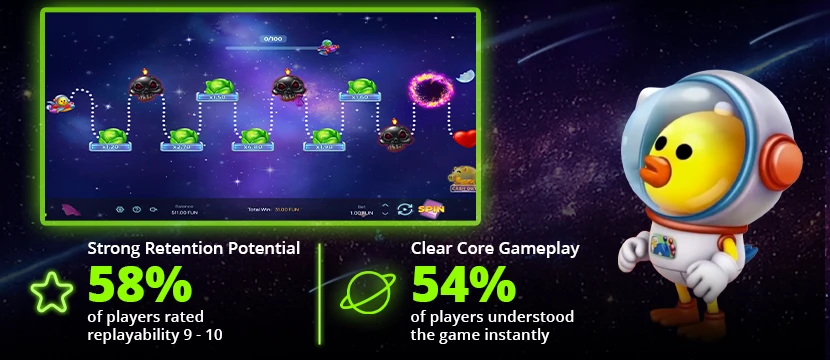
One of the strongest signals from the survey was players’ willingness to return to Orbital Rush. The average score for the likelihood of re-engagement was 8.03 out of 10, while the median score was 9 points. Nearly 58% of players rated it 9 or 10, which points to solid engagement during testing and a strong potential for audience retention.
Clear foundation of the game
We also measured how easy it was to understand the main idea of the game. Answering the question “How clear is the core concept?”, respondents gave Orbital Rush an average score of 3.66 out of 5, with a median of 4. More than 54% of surveyed players rated clarity at 4 or 5, suggesting that most players grasp the key mechanics and gameplay quickly without long onboarding.
Positive Reception of the Atmosphere
When asked to describe Orbital Rush’s overall atmosphere, most players used clearly positive language. The two most frequent descriptors were the following:
- Dynamic – 42% of mentions.
- Fun – 37% of mentions.
Negative characterisations such as “too chaotic,” “too slow,” or “lacking depth” accounted for less than 20% of responses combined. This suggests that the game's pacing and atmosphere align well with audience expectations.
Strong Response to the Character Design
The main character – the cosmic Duck – turned out to be one of Orbital Rush’s most successful elements in terms of player perception. The poll results split as follows:
- 45% of respondents chose the Duck, while 24% preferred the chicken.
- Character’s charisma score averaged at 3.82 out of 5, with a median rating of 4.
These results point to real branding value. The Duck is not only a likeable protagonist, but also a recognisable symbol that can carry the identity of Orbital Rush across marketing materials.
Correct Perception of the Game’s Genre
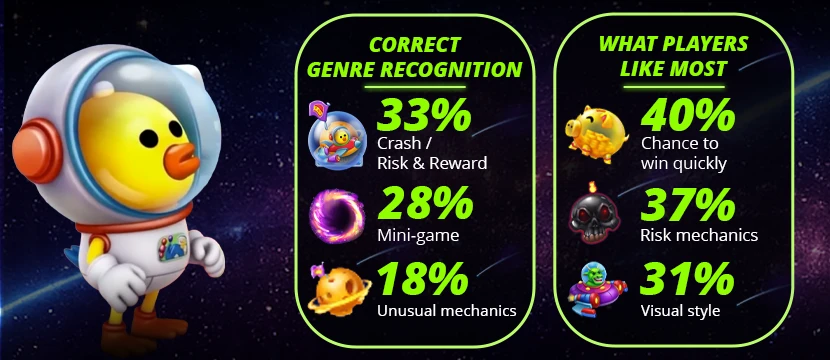
Survey responses show that players interpret Orbital Rush’s positioning in a fairly accurate way. When asked to define the game’s genre, the answers split as follows:
- Crash / Risk & Reward – 33% of respondents.
- Mini-game – 28% of respondents.
- Unusual slot-related mechanics – 18% of respondents.
Overall, this distribution suggests that the audience understands Orbital Rush intuitively. Most players recognise the risk-oriented nature of the gameplay and place it in the right category, even if they describe it using slightly different labels.
Most Appealing Elements for the Players
To understand what drives interest in casino-style titles, we asked respondents which elements they generally find the most attractive. The top answers aligned closely with what Orbital Rush is built around:
- Chance to win quickly – 40% of respondents.
- Risk mechanics – 37% of respondents.
- Visual style – 31% of respondents.
This distribution supports the overall direction of the project. Orbital Rush is designed around short-session outcomes, risk-driven decision-making, and a strong visual identity – and the survey suggests these pillars match what players actively look for in this type of experience.
Experienced Target Audience
The survey showed that most of the players are already familiar with similar step-based games. The results were as follows:
- 79% of respondents played similar games at least once within the last 30 days.
- More than 42% launched comparable games five or more times in the past month.
This indicates that Orbital Rush was evaluated by an audience that understands the genre well, which makes the collected feedback especially valuable.
High Level of Community Engagement
One more metric worth highlighting is how willing players were to stay involved in shaping and iterating the product. When asked about participating in a follow-up interview, 72% of respondents said they would be interested.
This level of engagement suggests genuine interest in the game and gives us a strong foundation for collecting high-quality feedback.
Key Retention Takeaways
To identify what could limit long-term retention after release, we asked respondents why they usually stop playing similar games. The most common reasons were distributed fairly evenly, with four factors standing out:
- Boredom – 23% of respondents.
- Repetitive gameplay – 23% of respondents.
- High randomness – 23% of respondents.
- Slow round pace – 19% of respondents.
These results highlight clear directions for future tuning and improving audience retention after release, as well as give a solid understanding of focus areas when producing future CrossyRun™ titles.
Hanna Nezhavets, Brand and Marketing Manager at Riddec Games, explained why user research became a core part of Orbital Rush’s pre-release process:
One idea I really wanted to bring into this project – and one I hope to keep developing further – is user experience research. In the world of mobile apps and mobile games, working with user feedback is considered the gold standard. Coming from that space, I really wanted to implement the same approach in an iGaming project.
Our goal wasn’t simply to run a marketing campaign before release. We wanted to create a space where players could directly influence the development of the game. We listened, analysed, and passed every important remark to the development team. Sometimes that meant extra working hours for the team, fast iterations, and urgent implementation of new solutions. Over the last few weeks, the entire team worked at an extremely intense pace, but the result was worth it.
It’s especially inspiring to see how player ideas and comments turn into real mechanics, UI improvements, and new features. That developer–audience interaction is exactly why we started this in the first place.
I also want to say a few words about Duck Fighter – a mini-game we created specifically for the social tournament together with SlotCatalog. The idea came from childhood nostalgia – arcade machines, early consoles, and simple but genuinely engaging fighting games. We truly hope Duck Fighter evokes the same positive emotions.

Conclusion
The survey results confirm that Orbital Rush already has several clear strengths – a recognisable and well-received main character, an engaging risk-driven mechanic, a high likelihood of repeat sessions, and a positive atmosphere that resonates well with the target audience. The replay signal is also strong – nearly 60% of respondents rated their likelihood of return as very high, while 72% said they’re open to staying involved with the project and sharing more feedback.
Taken together, these signals create a solid foundation for a successful launch and long-term growth. The survey also pointed at specific areas to keep tuning, and it gives the team a clear vision of moving forward as the CrossyRun™ line continues to expand.